Friday, May 4, 2012

"Priest" Is An Especially Lousy Action Movie With Very Little Compelling Action


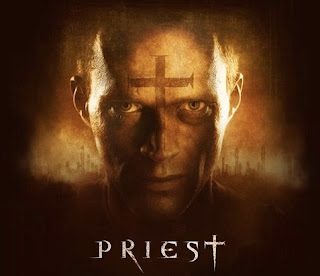
Priest
Priest, the 2011 film that reteams director Scott Stewart with Paul Bettany (the pair directed and starred in Legion, respectively), is an adaptation of the Korean comic series of the same name by Hyung Min-woo. However, the Priest of Korean print tells a very different story than that of its Hollywood movie counterpart. Instead of battling fallen angels, the American Priest fights beastly vampires – who sleep in coffins and keep humans as pets.

That said, plenty of comic book-turned-movie adaptations have benefited from creative liberties here and there. While Stewart’s Priest has certainly taken more liberties than most – it’s still possible that the final film is better for the alterations, right?

Unfortunately, Priest joins other lackluster films (such as My Soul to Take) that were delayed upon completion and retrofitted with post-converted 3D to help attract audiences to a film that otherwise has very little going for it – aside from a few slow-motion-heavy action set pieces. The alteration to the core Priest storyline (originally about an undead pilgrim who is reborn after merging with a supernatural force) creates one of the weirdest narrative mishmashes in recent memory.

One of the most disappointing aspects of Priest is the shameless lack of world-building. In case you’re unfamiliar, the film takes place in a (potentially) fascinating alternate world where humans and beastly vampires have warred for centuries (The Crusades, World War II, etc) – though the film never takes advantage of this foundation. To turn the tide, the Church unleashes “the Priests,” humans with super-human-like reflexes, who drive the vampires into exile.

Humanity takes shelter in large fortified Church-run cities, and instead of eradicating the vampires altogether, the creatures of the night are quarantined in concentration camp-like facilities, while the Priests are forced to live in obscurity, since the church fears the warriors might rebel against the aging religious regime. This status quo is sustained until a vampire attack on a farming community sends Bettany’s Priest on a journey of revenge which opposes the will of the church leaders, who (predictably) have become vain and subsequently brand Priest a trouble-maker, electing to ignore the vampire threat and attack the  noble warrior instead.

As mentioned, the film never really takes advantage of anything more than the most basic settings and story beats – never really touching on the vampire strata (i.e., that there’s more than one kind), the day-to-day lives of the surviving humans, or what could be an interesting juxtaposition in the character of Priest (a man of faith who enjoys killing). Instead, the film focuses on the cliché story of a “true” man of faith who must do God’s work – in spite of a vacuous and incompetent church organization. Even though the basic plot isn’t particularly fresh, Priest still had room to capitalize on its less-conventional aspects, given the film’s dystopian Western setting and intriguing mix of modern/traditional vampire tropes. Unfortunately, the movie is too one-note to take advantage of anything but a linear race to the final Priest-on-vampire battle.

While the phrase “Priest-on-vampire battle” might sound epic and exciting, the film manages to underwhelm even in the one area that many action fans were looking forward to –the action. Sadly, there are really only about three action set-pieces in the film and the first one is (by far) the best; after that strong start, the film never manages to regain momentum. Despite a couple of isolated fight sequences during the climax, the whole thing mostly goes out in a non-sensical whimper (especially if you’re Cam Gigandet’s character, Hicks).

While it might sound like brow-beating, the problems with the story and action sequences are largely predicated on the film’s ability to make even a character as (theoretically) badass and (potentially) interesting as Priest into a complete bore. Similarly, Karl Urban’s “Black Hat” is kept in the shadows so long that, by the time he’s fully revealed, it has already become clear that there’s very little substance to the character – or his backstory. Gigandet (best known as James from Twilight) plays a Western Lawman (the aforementioned Hicks) who provides a few entertaining moments, but mostly serves as a foil for Priest, and an excuse for Bettany to deliver heavy exposition about the in-and-outs of vampire hunting.

Even the more successful character moments are undermined by some of the most clichéd and heavy-handed dialogue in recent memory. Priest just mutters generalities under his breath; Black Hat spouts the Greatest Hits of essential villainous platitudes –  “You’ve done well” and “I’m counting on it”; Maggie Q (who plays her usual contemplative female warrior role) has the only heartfelt and (almost) charismatic dialogue in the film. Sadly though, the lack of execution with the rest of the project makes even the moments between Priest and Q’s Priestess come across as overly-melodramatic.

Similar to the film’s twist (which has very little bearing on the emotional complexity of the story), the 3D in Priest is entirely unnecessary and is one of the more egregious attempts at selling audiences on a mess of a film by slapping post-converted 3D on it. The 3D itself doesn’t fail as bad as the infamous Clash of the Titans post-conversion but it’s still entirely unnecessary and only succeeds in not making the film any worse than it would be – except for the higher ticket price.

Inevitably, some action fans will read this review and say something along the lines of, “It’s just an action movie – it doesn’t need character development or competent dialogue.” and I somewhat agree. In some cases, it’s fair to overlook whether a movie is technically good, in favor of it being immensely entertaining (Fast Five is a good example). However, Priest is an especially lousy action movie with very little compelling action, boring characters, and a convoluted plot, all put together by a group of filmmakers who failed entirely at capitalizing on the more compelling aspects of the core concept. And given that they had an extra year to get the film into theaters (it was originally set for an August 27th 2010 release), it’s only more disappointing that most that was done to try to salvage the wreckage was tempting audiences with a post-conversion 3D gimmick.

Friday, April 27, 2012

"Drag Me To Hell" Provides Plenty Of Very Effective Jump Scares


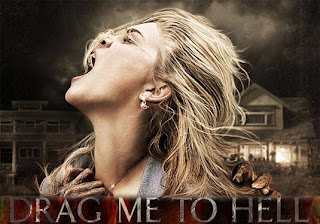
Drag Me To Hell
Sam Raimi's long-awaited return to the horror genre, Drag Me to Hell, is a fun, frightening blend of terrified screams and disgusted, gut-wrench laughter that aims to recapture the genre-bending spirit of Raimi's pre-Spider-Man cult favorites like Evil Dead II. So if you're a member of the hardcore Raimi elite, rest assured that this is the film you've been waiting nearly a decade for. But despite its wild entertainment value, the film also begs a few important, if somewhat controversial, questions. At what point in a celebrated director's career do audiences simply become too forgiving? Is having a particular cinematic style or point-of-view, no matter how dynamic, sufficient to excuse a few notable shortcomings? And does it matter how something makes you scream or laugh, so much as that it made you react at all?

But before we tackle some of the bigger issues associated with Drag Me to Hell, we should say from the outset that this film is absolute, undiluted Raimi -- his love-letter to those fans who've waited patiently for a departure from the mainstream and a return to his kinetic, tongue-through-cheek brand of horror-comedy. The film is simultaneously loud, fast, brutal, hilarious, disgusting, dark and whimsical, combining legitimate scares with gruesome, almost slapstick gags to great and bloody effect. Drag Me to Hell is, without a doubt, the kind of film where, if you're pre-disposed to love it, you absolutely will.

For those less familiar with the film, Drag Me to Hell is the story of a young woman named Christine (Alison Lohman), who in an effort to get promoted at the bank where she works denies the pleas of an old gypsy woman (Lorna Raver) to extend the loan on her family home. After a violent, and distinctly Raimi-esque, attack in the bank's garage later that evening, the gypsy places a curse on Christine, calling down the demonic Lamia to plague her for three terrifying days before finally coming to drag Christine, quite literally, to Hell. This is explained to Christine by a palm-reader at the objection of Christine's more level-headed boyfriend, Clay Dalton (Justin Long).

From this point, the script written by Raimi and his brother Ivan, becomes a rollercoaster of emotion for Christine who seeks out the help of a psychic, Rham Jas (Dileep Rao) who breaks the bad news to her. Needless to say, hilarity does not ensue – but plenty of really, really bad things happen over and over.
Are there scenes in the film where the main character does something ridiculous and implausible? Plenty. Does she take an awful lot of punishment without showing any signs of wear? Absolutely. Do you jump out of your seat even when you can feel that Raimi is trying to scare you? Every time!

The genius of the script is that sometimes in films, bad things happen to random people without provocation. But he takes us through Christine’s psyche and moral center as we explore how she extricates herself from awful predicament.

While some of Raimi’s scenes are tremendously suspenseful, the director makes sure to balance the story out with plenty of humorous moments designed to take just a little bit of edge off of the story. Int the process, the film can be an enjoyable experience, especially if viewed with a group of friends. Reminiscent of classic 1970s horror films that were best experienced if one speaks to the screen, “Drag Me To Hell” may be one of the most entertaining horror films made in quite awhile.

Despite my historical reluctance to embrace these visual theme rides, “Drag Me To Hell” may not be the perfect scary movie but one thing for sure is that Raimi has a handle on his material from start to finish and while the story may go off the rails every now and then by the time it pulls back in the station you will enjoy the ride!

Tuesday, April 24, 2012

"Stake Land" Is An Indie Vampire Movie That Is Actually Worth A Watch

Stake Land
Stake Land is an indie vampire movie that is actually worth a watch – and that’s saying something, considering how flooded the vampire sub-genre has become in recent years.

The movie is an ultra low-budget flick featuring some hammy performances, but it also manages to weave an interesting (if not slightly cliched) story and present us with some interesting characters worth following. It also features some great imagery, captured along the backroads of the American countryside.

The premise is this: Vampires have overrun America and the human population has been severely dwindled, with “civilization” reduced to clusters of Wild West-style towns. Enter Martin (Connor Paolo), a young teenage boy whose family is attacked by a bloodsucker the night they were set to leave their home to escape the oncoming vampire onslaught. Martin of course survives, aided by the mysterious vampire hunter known only as “Mister” (Nick Damici). Mister takes the orphaned Martin under his wing, trains him, and eventually the two set out on the road, traveling from The South up North toward the prophesied safe haven across the boarder in Canada (insert Canada vs. America jokes here).

Along the way Mister and Martin encounter other travelers, such as a Nun (Top Gun star Kelly McGillis), a pregnant Bar Maid (Halloween star Danielle Harris) and an ex-Marine (Sean Nelson). They also encounter threats at every turn, including the various bloodsuckers roaming the night, bandits, rapists, cannibals, and worst of all, a fanatical militant sect known at The Brethren, led by a maniacal extremist named Jebedia Loven (Micahel Cerveris, a.k.a. The Observer on Fringe).

Stake Land is basically a mashup between your standard vampire horror film and your standard road trip movie, but somehow this movie manages to avoid being so standard that it crosses into boredom. What keeps this indie film treading water is pretty much a combination of some smart direction by Jim Mickle, and a great cast of solid (if not well-known) actors who work well as an ensemble.

Veteran actor Nick Damici portrays “Mister” as a classic Clint Eastwood gunslinger – a hard man of no name and few words who kicks ass at the drop of a hat. While Mister is the most dynamic character to watch, Martin is really our window into this story, and Connor Paolo (who played the young version of Kevin Bacon’s character in Mystic River) succeeds at his only real task: keeping Martin from coming off as annoying. As a boy forced to mature before he’s ready, Martin has the same morbid curiosity about the crumbling world around him as we do. Martin’s development over the course of the film – having to face serious ugliness and pain in a savage world – is also interesting to watch, thanks in large part to Paolo’s competent handling of his role as leading man.

The supporting cast is also strong. I almost didn’t recognize Kelly McGillis as the woman who stole Maverick’s heart in Top Gun, but here she’s just as effective, playing a Nun trying to hold on to her faith in the face of such unholiness. Her character comes and goes throughout the film, but commands real attention in the scenes that she’s in. Danielle Harris is something of an icon on the indie horror circuit, and here she plays her usual spitfire character, this time complicated by the fact that she’s also extremely vulnerable as a pregnant girl about to pop. Longtime character actor Sean Nelson gets little to work with, but is solid in the bits he does get.

Stake Land
Michael Cerveris gets to flaunt his Tony Award-winning theatrics, hamming it up as the maniacal Jebedia. For my part, I thought that Cerveris’ character was the only aspect of the story that caused Stake Land to drag somewhat, mainly because Jebedia is a flat caricature that we’ve seen so many times before. He mainly distracted from the stronger plotline involving the Martin, Mister and their makeshift family, and the story ultimately reduces the character to being little more than cheap Deus ex Machina.

Unlike so many big-budget dystopian films these days, director Jim Mickle doesn’t need CGI-rendered images of destroyed Metropolises to really invoke the bleak world he’s trying to create. If nothing else, Stake Land‘s greatest accomplishment may be the landscapes and natural images shot in (I believe) the woodland areas of upstate New York, which Mickle uses to create his dystopian backdrop. Barren agriculture (naked trees) or old rusted infrastructure – bridges, abandoned factories, etc. – are the primary stages for the film’s outdoor scenes, while small working-class towns serve as the last metropolises in this half-dead world. No matter what he’s filming, Mickle is great about how he composes his shots, incorporating the architecture and agriculture at his disposal in a surprisingly artful way that gives the film greater levels of meaning. A good example of this is when Martin and Mister stop to camp in the hollowed bowels of an (actual) abandoned factory in the countryside; the image of the pair circled by the fire in the shadow of what was once mankind’s symbol of prosperity is haunting and relevant. Mickle maximizes these sorts of naturally occurring resources, which is tenacity worthy of commendation.

The script for Stake Land was written by Mickle and Damici, but thankfully there’s more doing than talking in the film. You won’t find a lot of scenes where characters are reflecting on the profundity of their dystopian circumstances, and when there are “dramatic” moments that require more dialogue and/or exposition (Martin’s voiceover narration or scenes with Jebediah) the movie isn’t nearly as strong. But, as stated, thankfully there is less talking and more doing in this film.

Finally, we couldn’t review a vampire movie without discussing the look of the vampires, right? In Stake Land the bloodsuckers are your classic breed – no sunlight, stake through the heart, etc. – though the film tries to twist the formula a bit by creating vamp sub-categories with their own strengths and weaknesses, which Mister teaches Martin about over the course of the movie. The makeup work is pretty much on the level with any episode of Buffy The Vampire Slayer, but the film mostly employs quick shots of creatures tackling victims, combined with screams and chomping sounds to convey carnage. A helicopter in one scene is basically a light in the sky, wind effects and chopper rotor sound effects; it’s a small-scale operation but it works for the most part.

In the end, Stake Land isn’t the best indie vampire flick ever made – it doesn’t do anything really new or revolutionary – but it’s far from being the worst. Fans of the genre will likely enjoy this entry – though I doubt that many moviegoers beyond that limited circle will have interest in what Stake Land has to offer.

Wednesday, April 18, 2012

'Don't Be Afraid Of The Dark'-An Actual Scary Movie

Don't Be Afraid Of The Dark
When seeing a scary movie in a theater, you always run the risk of encountering that obnoxious audience member – the one who loudly criticizes the characters onscreen as if they can hear him, or laughs at every scary moment, or generally complains how stupid the movie is. Typically, encountering such a person makes for a frustrating viewing experience; in the case of Don’t Be Afraid of the Dark, however, you’ll probably find yourself agreeing with him.

The other issue with the creatures is that, since they are ostensibly small CGI animals, the actors (who are not exactly convincing to begin with) don’t react in ways that coincide with the movements and actions of the creatures. This often involves characters glancing the wrong way, or appearing deaf to sounds the creatures are making – especially young Bailee Madison, who spends the most time alone onscreen and just isn’t equipped to make something convincing out of so much fantasy.

All in all, it’s impossible to recommend Don’t Be Afraid of the Dark to anyone but those who enjoy laughing at horror films which are totally stupid and cheesy. Anyone who wants an actual scary movie experience, or even just some mindless escapism, won’t find either of those things in this house.

 Haunted house films are back in full force. In April we got the beautifully modest and wildly enjoyable Insidious from James Wan and now Guillermo del Toro and Co. are giving the subgenre a go with Don’t Be Afraid of the Dark. While the two are rooted in entirely different core concepts, they do have quite a bit in common, namely child stars vs. evil entities, eerily warm yet threatening tones, fantastic visuals and the fact that they’re both incredibly frightening, exhilarating and entertaining all in one. Haunted house films are officially two for two in 2011.

Have you ever misplaced something and had someone tell you, ‘Well, it couldn’t have just wandered off on its own?’ Well, Don’t Be Afraid of the Dark is somewhat connected to that concept and offers a creepy explanation for bumps in the night, vanishing personal belongings and just about anything else you can’t attribute to normal human behavior in your home. It’s this all-too-relatable scenario that lets the film really get inside your head.

Don't Be Afraid Of The Dark
From there, co-writers del Toro and Matthew Robbins expand the basic premise to a point that practically creates a sort of subculture, almost along the lines of vampires and werewolves. No, it’s not quite as extensive or relatable, as the creatures in Don’t Be Afraid of the Dark aren’t humanized or glorified in the least, but even without getting inside their heads, the film offers a firm sense of their history and what they want. The very first scene takes place in the Blackwood Manor on the very day Emerson vanishes. While the moment does offer a significant amount of information in terms of what Emerson was battling, the situation is presented in a vague enough fashion so that we don’t quite know what we’re dealing with, making the next few scenes all the more terrifying.

Plus, talk about dramatic irony. Director Troy Nixey uses the standard horror set-up, delivering an especially disturbing opening scene, making it even more nerve-wracking to see little Sally walk right into this house of horrors. Not only is Madison quite adorable, but the character herself snags all of your sympathy from the moment she steps on screen. She’s a seemingly sad kid being bounced between her divorced parents; how can you not feel for her? Rubbing it in even further is Madison herself as at just 9-years-old during production, she’s as talented as they come. As she’s the center of this story, without a stellar Sally, this supernatural tale wouldn’t have been believable in the least. However, Nixey found a young actress capable of selling it big time, making the experience unnervingly authentic.

The adult characters suffer the slightest bit as Madison steals the show. Both Pearce and Holmes, make for endearing parental figures, Pearce the inexperienced father and Holmes the fill-in desperately seeking Sally’s approval. Between their intimate relationship, their work partnership and this ill-structured family they’re trying to create, their connection is far more unique than with most on-screen couples. While Pearce fades into the background at a point, putting one foot in the trap of the guy who continually denies Sally’s claims regardless of the fact that there’s so much proof, Holmes steps up big time, considering Sally’s accusations and building an intriguing relationship with her in the process. Sure, Kim tiptoes around exposing the truth a bit longer than necessary, but it does give the film the chance to build additional suspense before the grand finale.

From a technical standpoint, the standout elements of Don’t Be Afraid of the Dark are the evil creatures. Nixey takes his sweet time exposing them and when we finally get a good look at what’s been whispering to Sally, the visuals are surprisingly satisfying. They’re frightening, but come with a hint of vulnerability, making them all the more believable. In terms of other scare tactics, Nixey sticks to the book using tracking shots and eerie reveals to create a powerfully ominous tone. Sure you always know danger is on the horizon, but Nixey manages to conceal the threat just enough that when it finally comes, despite having your guard up, it still makes you jump.

Overall, Don’t Be Afraid of the Dark is an excellent blend of sheer terror and frightening fun. You might feel the need to check under the covers before getting in bed after seeing this one, but ultimately, it doesn’t stick with you on a disturbing level, rather simply because it’s a blast to watch.

Tuesday, April 10, 2012

"Wolvesbayne"-A Werewolf Hero Takes On A Vampire Cult

Wolvesbayne won't win any awards for originality, but as I've said in the past, if you aren't going to bring anything fresh to the table you better make sure to retread familiar territory in an entertaining fashion. This is exactly what director Griff Furst and company manages to do until the overwritten script begins to collapse in on itself during the second half. The breezy pace and enthusiastic cast is almost enough to make you overlook a most annoying turn the story takes.

One thing I do suspect viewers of this fast-paced action horror flick will have a hard time overlooking is how little screen time werewolves get despite ostensibly being billed as a werewolf movie. You can watch and tell every penny of the film’s limited budget is on the screen; maybe with a few more pennies they could have afforded to give the werewolves more face time.

Jeremy London ("Party of 5", "7th Heaven"), showing more personality than usual, stars as greedy real estate developer Russel Bane; a chance roadside encounter with a werewolf leads to him inheriting its curse. After going through the usual newly cursed werewolf motions, the arrogant businessman goes seeking the assistance of the pretty proprietor of an occult shop (Christy Carlson Romano, the voice of Disney's "Kim Possible") he had been scheming to acquire the deed to. She has her own lycanthrope secret and takes the reluctant Bane under her wing to train him in the ways of the werewolf.

Bane’s werewolf problem quickly turns into a vampire problem when he garners the attention of a clan of vamps led by Marc Dacascos as Von Griem, a debonair bloodsucker fed up with his kind having to hide in the shadows.

That the vamps have splintered off into various factions that cannot seem to get along with each other complicates matters. Von Griem resurrects uber vampire Lilith (Yancy Butler, vamping and camping it up all at once, a vampire queen by way of "Mommy Dearest" Joan Crawford) hoping that she can help bring unity to their legion and lead them into a new era of fanged glory. Doing so will require them to acquire a series of amulets that will fully return Lilith's god-like power.

With the exception of a sexy vampire assassin (Stephanie Honore, soon to be seen in Final Destination 3D) these vampires don't do a whole heck of a lot that could be construed as vampiric. More of the World of Darkness "Vampire: The Masquerade" variety, which means excessive amounts of vampire politicking and an overemphasis on talking about what they're plotting rather than actually doing what they're plotting.

Bane gets roped into working with a team of vampire hunters, the leader of which, Jacob Van Helsing, played by former Asylum regular Rhett Giles, demonstrates a take-no-prisoners attitude that doesn’t sit well with Bane.

In fact, all of these vampire hunters are straight out of an Asylum film: Bram Stoker's Dracula's Curse, to be exact. Screenwriter Leigh Scott wrote and directed that film back in his days working for The Asylum and brings a few of those characters back to life in this non-Asylum film. Though these vampire hunters are a colorful lot and Rhett Giles is an underrated actor who makes for a credible vampire slayer, the introduction of this clan of vampire hunters where the Wolvesbayne begins to derail.

Russel Bane's progression from selfish jerk to reluctant werewolf superhero gets put on the back burner, along with his potential were-girl love interest, going from title character to second, maybe even third fiddle as the returning characters from Dracula's Curse waltz in around the 50-minute mark and completely takeover the movie. I figured if nothing else it was all setting up Bane’s big moment during the final battle when he’d use his werewolfism to save the day, but, and this really is hard to believe, that's not exactly how it goes. His big moment doesn't even involve the use of his wolfman powers and Lilith's downfall is almost entirely Van Helsing's doing.

Imagine you're watching the Wolverine origin movie. Two-thirds into the film the X-Men show up; recruit him, and from that point on he just becomes another face in the crowd while Professor X, Cyclops, and Storm dominate the proceedings and lead the charge against the bad guys. Then the final battle hardly involves Wolverine; he barely brandishes his claws and is just kind of there while other X-Men vanquish the villains. People watching a Wolverine movie probably want to watch Wolverine rip the bad guys to shreds, not smiling politely off to the side while Cyclops blasts the main supervillain into oblivion.

When Wolvesbayne was over I kind of had the feeling I'd just spent 90-minutes watching the superhero origin movie for a minor supporting sidekick. Even then the film is not half bad, but I can't help but come away feeling a bit soured by the lack of werewolf action in what's being billed primarily as a werewolf movie and then having that werewolf character we’re emotionally invested in all but sidelined by a group of secondary characters that dominate the entire third act.